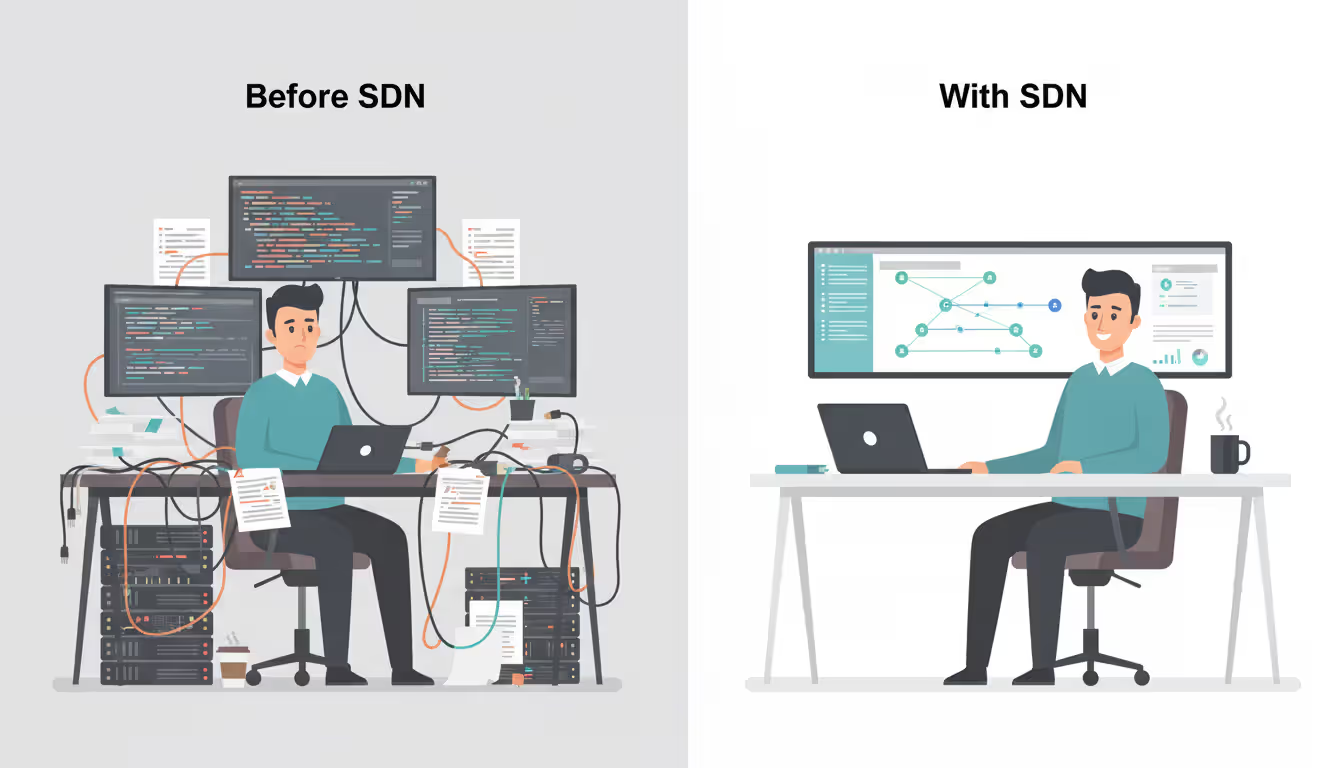
A software defined network (SDN) changes how companies build and run their network infrastructure. Think of it this way: traditional networking means configuring each switch and router individually—logging into devices one by one, typing commands, hoping you didn't miss anything. SDN flips this model. It pulls the "brain" (decision-making) away from individual hardware boxes and puts it in centralized software where you can see and control everything from one place.
Here's what makes this different. The physical equipment—your switches, routers, access points—still moves packets at full speed. But they're no longer making independent decisions about where traffic should go. Instead, they take instructions from a central controller that sees your entire network topology and can make coordinated decisions across all devices simultaneously.
Why does this matter? Picture a bank deploying a new security policy across 200 branch offices. Traditional approach: someone (or a team) configures 200 devices, probably takes days, definitely introduces errors. SDN approach: update the policy once in the controller, push it everywhere in minutes. Same result, fraction of the time, fewer mistakes.
Major financial institutions now run SDN in production. So do cloud providers like AWS and Azure (they couldn't operate at their scale without it), telecom companies managing massive subscriber bases, and healthcare systems that need to isolate patient data while maintaining fast access for doctors. The technology has moved well beyond experimental—it's handling real traffic for organizations that can't afford downtime.
Understanding Software Defined Network Architecture
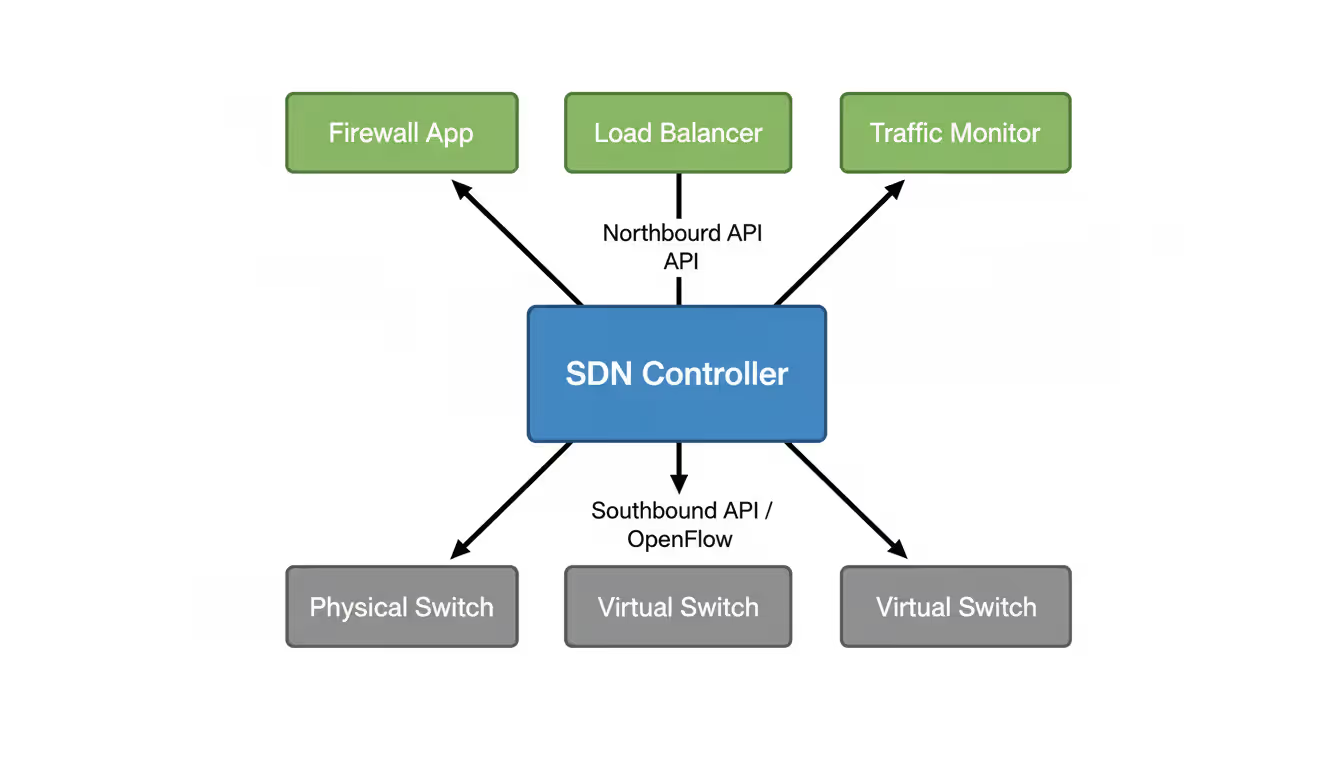
Software defined network architecture breaks into three layers, and understanding how they connect matters more than memorizing their names.
Start at the bottom with the infrastructure layer. This is your actual hardware—physical switches in data centers, routers connecting offices, wireless controllers managing access points. These devices still do what they've always done: move packets really fast. What's different? They wait for instructions instead of running complex protocols to figure things out themselves. A switch receives forwarding rules from above: "traffic matching these characteristics goes out port 5 at high priority." It applies those rules at wire speed, but it didn't decide them.
The control layer sits in the middle, running SDN controller software. This is where the intelligence lives. Controllers maintain a live map of your entire network—every device, every link, current traffic loads, which paths are available. When something changes (a link goes down, a new device connects, traffic patterns shift), the controller sees it immediately and recalculates. Then it pushes updated instructions down to the infrastructure devices affected by that change.
Think of the controller as air traffic control. Individual planes (packets) fly fast, but they follow directions from controllers who see the whole picture and coordinate everything to prevent collisions and optimize flow.
The application layer runs on top, hosting software that implements specific network behaviors. You might have a firewall management application that tells the controller "block all traffic from these IP ranges." Or a load balancing app that monitors server health and adjusts traffic distribution. Or custom Python scripts your team wrote to automate common tasks. These applications don't talk directly to switches—they tell the controller what they want, and the controller translates those high-level requests into specific device configurations.
Separating the control plane from the data plane is the key innovation here. Legacy networks combine both: each router runs BGP to learn routes (control plane) while simultaneously forwarding packets (data plane). This works, but it's inefficient. Why run the same routing calculation on 50 routers when one controller can do it once and distribute the results? SDN centralizes the expensive computational work while keeping the fast packet-forwarding distributed across specialized hardware.
One controller can manage 500+ switches. Or 5,000 in larger deployments. You're not giving up distributed packet forwarding (that stays fast), just centralizing the brainwork.
The transition to software defined networking isn't just about technology—it's about changing how network teams operate. We've moved from configuring individual boxes to programming infrastructure as code, which requires new skills but delivers unprecedented agility
— Jennifer Morrison
But centralization creates a risk. What happens if your controller crashes? Production deployments run multiple controllers in clusters, typically three or five instances. They synchronize state between themselves, so if one fails, the others take over. Switches can also cache forwarding rules locally, so brief controller outages don't immediately break traffic flow—packets keep moving based on the last known good configuration until controllers come back online.
Key Components of Software Defined Networking
Let's get specific about the pieces that make software-defined networking actually work in practice.
SDN controllers come in different flavors. OpenDaylight, ONOS, and Ryu are popular open-source options—free to use, customizable, but you're on your own for support. Network vendors like Cisco, Juniper, and Nokia sell commercial controllers with slick interfaces, support contracts, and pre-built integrations with their hardware. Which to choose? If you've got developers on staff and want maximum flexibility, open-source makes sense. If you need someone to call at 2 AM when things break, commercial is safer.
Controllers store the network topology in a graph database, run shortest-path algorithms when calculating routes, and expose programming interfaces (APIs) so applications can interact with them. They're receiving constant updates from infrastructure devices—link status changes, new device registrations, flow statistics—and using that data to maintain an accurate real-time model of network state.
Southbound APIs are how controllers talk to infrastructure devices. OpenFlow is the protocol everyone knows—it defines exactly how a controller installs forwarding rules in a switch's flow table. "If you see a packet from 10.1.1.5 going to 10.2.2.8, forward it out port 12 and mark it with QoS priority 5." Switches understand these instructions and execute them at hardware speeds.
But OpenFlow isn't the only option. NETCONF handles device configuration (VLANs, port settings, management interfaces). OVSDB manages virtual switches in hypervisors. Some vendors have proprietary APIs that expose features OpenFlow doesn't cover. The API choice matters when mixing equipment—not all devices speak all protocols, so you need compatibility between your controller and your switches.
Author: Megan Holloway;
Source: baltazor.com
Northbound APIs connect controllers upward to applications. Here's where standardization gets messy—there's no single dominant protocol like OpenFlow on the southbound side. Most controllers expose REST APIs (HTTP-based interfaces where applications send JSON-formatted requests). An application might query "GET /topology/links" to retrieve the current network map, or POST a new policy configuration to "/firewall/rules."
Some platforms offer Python libraries for easier integration. Others support event streaming through message queues, so applications receive instant notifications when network state changes rather than polling repeatedly. The lack of standardization means applications often need customization to work with different controller platforms.
Network applications implement actual functions. A bandwidth calendar app lets users reserve high-priority network capacity for specific time windows (useful for scheduled data backups or video broadcasts). DDoS mitigation apps detect attack patterns and automatically reroute or drop malicious traffic. Automated remediation scripts watch for common problems and apply fixes without human intervention.
These applications read data from controllers, apply logic (could be simple rules or machine learning models), then write back configuration changes. A traffic engineering app monitoring link utilization might notice that the path between two data centers is getting congested. It calculates an alternate path, checks that it has sufficient capacity, then instructs the controller to reroute some flows. All of this happens programmatically, no human clicking through interfaces.
Virtual switches extend SDN into virtualized environments. Open vSwitch (OVS) is the standard here—it runs on hypervisors like VMware ESXi or KVM, connecting virtual machines to physical networks. OVS speaks OpenFlow, so your controller manages it just like physical switches. This creates consistency: the same policies apply whether traffic flows between VMs on one server or across your whole data center.
Container platforms use similar concepts. Kubernetes network plugins create virtual switches that connect pods (containers) to each other and to external networks. These can integrate with SDN controllers, allowing consistent policy enforcement from physical infrastructure through virtual layers up to containerized applications.
Here's how these components interact in practice. A packet arrives at a switch that doesn't have a matching forwarding rule. The switch sends "packet-in" message to the controller via OpenFlow: "I got this packet, what should I do with it?" The controller checks with any relevant applications through northbound APIs—maybe a firewall app needs to approve this traffic, or a load balancer app wants to direct it to a specific server. The controller calculates the appropriate action, then sends flow rules back to the switch via OpenFlow. Future packets matching that pattern get forwarded at full hardware speed without bothering the controller again.
Traditional Networks vs Software Defined Networks
The gap between traditional and software defined networks shows up in daily operations, not just architecture diagrams.
Feature
Traditional Networks
Software Defined Networks
Control mechanism
Each device runs protocols like OSPF or BGP independently
Single controller manages all devices with complete network visibility
Management approach
Log into each device via CLI; configure one at a time
API-driven policy management from central interface
Scalability
Every new device needs individual configuration; routing protocol updates take time to converge
New devices pull config automatically; controller handles scale complexity
Configuration method
CLI commands, manual change windows, hope you didn't typo anything
Infrastructure-as-code stored in Git; automated testing before deployment
Hardware dependency
Vendor-specific operating systems tightly integrated with hardware
Commodity switches run open operating systems; behavior defined by software
Cost structure
Expensive specialized hardware; locked into vendor upgrade cycles
Cheaper white-box hardware; pay for controller software and expertise
Flexibility
New features require hardware replacement or waiting for vendor firmware
Deploy new capabilities through application development
Troubleshooting
Check logs on multiple devices; correlate timestamps; guess what happened
Query controller's centralized state; see complete traffic paths
Traditional networks distribute intelligence across every device. Each router independently runs BGP to exchange routes with neighbors, runs OSPF to discover local topology, runs spanning tree to prevent loops. This autonomy provides resilience—no single device controls everything—but creates management headaches.
Imagine you need to implement a new security policy blocking traffic from certain countries. Traditional network: you log into your edge routers (maybe 10 of them across different locations), find the access-list configuration section, add the blocking rules, save the config, verify it worked, document what you did, hope you didn't break anything. Takes hours if you're experienced, could take days if you're not. And if the business requirements change next week, you do it all again.
SDN version: you update the policy definition in your security application (or push it via API if you're automating), the controller distributes new flow rules to relevant edge switches, done. Takes minutes. Changes next week? Update the policy, push again.
The resilience tradeoff is real though. Traditional networks keep working if one device fails—other routers adapt their routing tables and work around it. SDN networks need controller availability guarantees. Lose your controller and devices keep forwarding based on existing rules, but you can't make changes or adapt to failures until controllers come back. That's why production SDN runs controller clusters with automatic failover.
Flexibility differences become obvious when you want to try something new. Traditional networking: if you want advanced traffic engineering, you check if your hardware supports it, maybe discover you need a software license upgrade, possibly find out your equipment is too old and you need to buy new gear. Then you configure it on every relevant device.
SDN: you write an application (or download one someone else wrote), test it in a lab network segment, deploy it to production via the controller. Want to try a different traffic engineering algorithm? Write a different application. A/B test them on different traffic flows. Roll back if it doesn't work. This is why cloud providers love SDN—they're constantly testing new approaches to optimize their networks, and SDN makes experimentation practical.
Cost comparison isn't straightforward. Small networks (under 50 devices) often find traditional networking cheaper—less complexity, lower learning curve, established vendor support. Large networks (500+ devices) or environments with frequent changes see SDN pay off through operational efficiency. You spend less time configuring devices manually and more time on higher-value work like capacity planning and application optimization.
Software Defined WAN and Data Center Applications
SDN principles scale beyond local networks to wide-area connectivity and complete data center automation.
What Is a Software-Defined Data Center
A software-defined data center (SDDC) applies programmability across all infrastructure—compute, storage, networking, security—managed through unified orchestration. Instead of separate teams managing VMs, storage arrays, network switches, and firewalls independently, SDDC treats everything as software resources that applications can request automatically.
Deploy a new three-tier web application in a traditional data center: submit tickets to the server team (wait 3 days), storage team (2 days), network team (2 days), security team (5 days because they're backlogged). Hope nobody misconfigured anything. Maybe two weeks total if you're lucky.
SDDC version: developer submits application requirements to orchestration platform (VMware vCenter with vRealize, OpenStack, or similar). System automatically provisions VMs on available hosts, allocates storage volumes, creates isolated network segments using SDN, configures load balancers, applies firewall rules, connects everything together. Application is running in 20 minutes.
The networking piece uses SDN controllers to create virtual networks on demand. Each application gets its own isolated network segment (VXLAN overlay, typically), with inter-segment traffic flowing through virtualized firewalls. Physical network becomes a simple IP transport layer—the interesting stuff happens in software overlays managed by the controller.
VMware's NSX is probably the best-known SDDC networking product. It creates virtual networks, virtual load balancers, virtual firewalls—all managed through APIs integrated with vCenter. Cisco ACI takes a different approach, managing both physical and virtual networks through a policy model where you describe application requirements and the system configures infrastructure to match.
Challenges? Integration complexity tops the list. Getting compute, storage, and network automation to work together smoothly requires careful planning. You need robust orchestration logic that handles edge cases—what happens when storage is available but network provisioning fails? How do you roll back partial deployments?
Skills gaps hit hard too. Traditional infrastructure teams specialize—network engineers know routing protocols but not storage protocols, storage admins know LUNs but not VLANs. SDDC requires broader knowledge or closer collaboration. Many organizations create dedicated cloud infrastructure teams combining expertise across domains.
Private cloud and hybrid cloud deployments benefit most from SDDC. If you're running on-premises infrastructure alongside AWS or Azure, having consistent automation and policy frameworks across both environments simplifies operations dramatically. Public cloud providers already offer this (their infrastructure is fully software-defined), so SDDC brings similar capabilities to private infrastructure.
How SD-WAN Improves Network Performance
Software defined WAN tackles wide-area connectivity—connecting branch offices, remote sites, and cloud services—with smarter path selection than traditional WAN architectures allow.
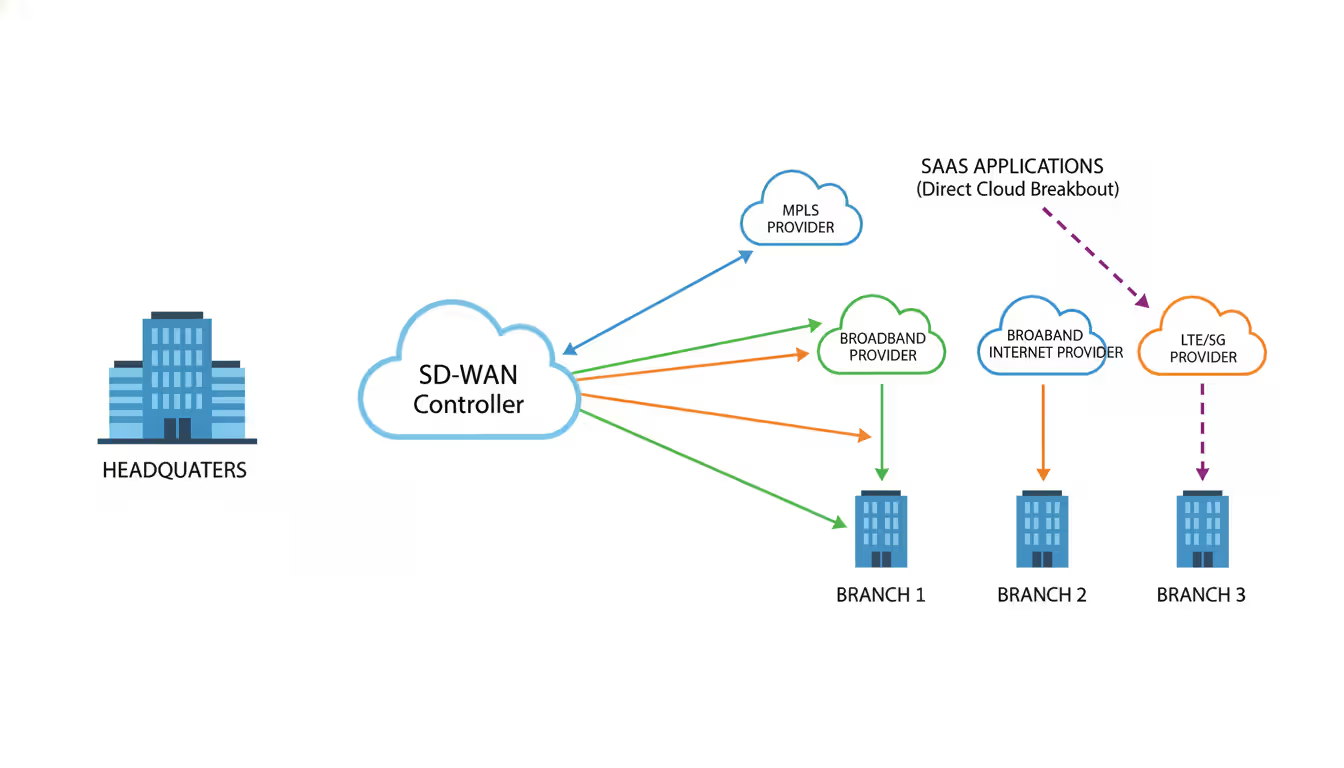
Old-school WAN design: lease an MPLS circuit from a carrier to connect each branch to headquarters. All traffic goes through headquarters (hub-and-spoke topology), even if someone at a branch office is accessing Office 365 in the cloud. This creates unnecessary latency (packets travel to headquarters then back out to Microsoft's datacenter) and wastes expensive MPLS bandwidth.
SD-WAN uses multiple connection types—MPLS if you've got it, but also broadband internet, LTE, potentially 5G. The SD-WAN device at each location monitors all available paths constantly, measuring latency, packet loss, jitter, and available bandwidth. It routes each application over the best path for that application's requirements right now.
Voice and video calls need low latency and low jitter, so SD-WAN sends them over whichever path currently offers those characteristics, even if bandwidth is limited. Large file transfers need high bandwidth but can tolerate some latency, so they use different paths. Cloud application traffic goes directly to the internet (local breakout) instead of backhauling through headquarters.
A retail company with 300 stores can replace expensive MPLS circuits with two cheap internet connections per store. The SD-WAN controller in corporate manages all 300 locations from one interface. Store opens in a new location? Ship them an SD-WAN appliance, plug it into internet circuits, it calls home to the controller and downloads its configuration (zero-touch provisioning). No IT staff visit required.
Performance improvements are measurable. Gartner case studies show companies reducing WAN costs 40-60% by replacing MPLS with broadband, while simultaneously improving application performance through intelligent path selection. A video conference that used to route through headquarters (adding 50ms latency) now goes directly to the internet, reducing latency to 15ms.
Application identification happens through deep packet inspection or integration with cloud service providers. The SD-WAN device recognizes Salesforce traffic, Zoom calls, AWS API requests, and applies appropriate routing policies to each. Some products integrate directly with cloud provider APIs to learn optimal paths to specific services.
Security requires attention because direct internet breakout means branch offices aren't protected by headquarters firewalls anymore. SD-WAN products include local firewall capabilities, or integrate with cloud-based security services that inspect traffic before it reaches the internet. This "secure access service edge" (SASE) model combines SD-WAN with cloud security.
Not every organization needs SD-WAN. If most of your applications run on-premises and you have few locations, traditional WAN works fine. But if you're adopting SaaS applications, running multi-cloud infrastructure, or managing many remote sites, SD-WAN's combination of cost savings and performance improvements is tough to beat.
Author: Megan Holloway;
Source: baltazor.com
Benefits and Challenges of Implementing SDN
Software defined network adoption delivers real advantages, but you'll hit some obstacles that require planning and investment to overcome.
Centralized management changes daily operations immediately. You're looking at one dashboard showing your entire network topology—every switch, every link, current traffic flows, device health. Need to check if a particular VLAN exists across all data center switches? One query instead of logging into 50 devices. Want to see the path traffic takes between two applications? The controller visualizes it.
Policy deployment happens everywhere simultaneously. Updating a firewall rule propagates to all relevant devices in seconds. This consistency eliminates configuration drift (where Device A has slightly different config than Device B because someone forgot to update it), a common problem in traditional networks that creates security vulnerabilities and troubleshooting headaches.
Automation capabilities are where SDN really shines. Integrate your SDN controller with your orchestration platform (Ansible, Terraform, Kubernetes, whatever you use), and network changes happen automatically based on application needs.
Container orchestration platforms do this today. Deploy a new Kubernetes service, the network automatically provisions load balancing, configures the right firewall rules, sets up routing. Scale the service up, the network adapts. Scale it down, resources are freed. No network engineer involvement required (though someone had to write the integration logic initially).
This automation reduces deployment time from days to minutes and eliminates manual configuration errors. But it requires different skills—you're writing Python scripts and API calls instead of typing CLI commands.
Agility and flexibility mean you can test new approaches without major commitments. Want to try a different load balancing algorithm? Write a small application that implements it, test it on a subset of traffic, measure the results, roll it out or roll it back. Takes days instead of months.
Network as a service becomes possible. Some organizations let application teams provision their own network resources through self-service portals backed by SDN automation. A development team can create an isolated network segment for testing, run their tests, tear it down—without filing tickets or waiting for network operations. This is standard practice in public clouds; SDN brings similar capabilities to private infrastructure.
Security concerns deserve serious attention. Your SDN controller has immense power—it can redirect traffic anywhere, disable security controls, modify firewall rules. Compromise the controller and an attacker could do massive damage very quickly.
Controller hardening is essential. Run controllers on dedicated infrastructure, restrict network access, require strong authentication, enable audit logging, keep software patched. Use role-based access control so not everyone can make every change. Encrypt the southbound API traffic between controller and switches so attackers can't inject malicious flow rules by intercepting network communication.
Defense in depth still applies. Don't rely solely on the controller for security. Deploy traditional firewalls at key boundaries. Segment your network so a compromise in one area can't spread everywhere. Monitor for anomalous behavior—if someone suddenly starts installing thousands of flow rules at 3 AM, that's suspicious.
Implementation complexity will slow you down initially. Ripping out your existing network and replacing it with SDN overnight isn't realistic (or wise). Most organizations run hybrid networks during multi-year transitions—legacy equipment in some areas, SDN in others. Managing both paradigms simultaneously takes effort.
Controller failures need handling. What happens to your network if the controller crashes? Switches keep forwarding based on existing rules, so traffic doesn't immediately stop. But you can't make changes or respond to failures. Production deployments use controller clusters (three or five nodes) with state synchronization, so losing one controller doesn't impact operations. You're adding complexity and cost for resilience.
Integration with existing tools matters. Your network monitoring system, your configuration management database, your ticketing system—they all need to work with SDN or you'll be managing two parallel systems. Some integration requires custom development. Budget time and resources for this.
Skill requirements shift significantly. Traditional network engineering emphasizes protocol knowledge—understanding how BGP selects routes, how OSPF calculates costs, how STP prevents loops. You still need that foundation, but it's no longer sufficient.
SDN adds programming requirements. Python is the most common language for network automation. You need familiarity with REST APIs, JSON data formats, version control (Git), software testing practices. Network teams without these skills struggle initially.
Options: train existing staff (takes time, not everyone will succeed), hire DevOps engineers with networking interest (hard to find, expensive), partner with consultants during early deployments (works but creates dependency). Many organizations do all three—training for team members who want to learn, selective hiring for new skills, consultant help for initial projects while building internal capabilities.
The cost-benefit math changes based on your situation. A 5,000-device network with constant changes and heavy cloud integration sees rapid ROI from SDN. A 50-device network that changes twice a year probably doesn't. Be honest about your environment and requirements before committing to the investment and disruption.
Author: Megan Holloway;
Source: baltazor.com
Common Questions About Software Defined Networks
What is the main purpose of a software defined network?
SDN pulls network control away from individual devices and centralizes it in software where you can manage everything programmatically. Instead of configuring each switch and router separately, you define policies once and the controller pushes them everywhere. This makes networks programmable—you can automate changes, integrate with orchestration systems, and treat infrastructure as code. The value isn't the technology itself, it's the operational agility and automation capabilities that centralized control enables.
How does SDN differ from network virtualization?
They solve different problems but often work together. Network virtualization creates multiple logical networks sharing physical infrastructure (like running multiple virtual networks on one set of switches). SDN provides programmable control over network behavior, whether physical or virtual. You can implement network virtualization without SDN using traditional methods, and you can deploy SDN without creating virtual networks. But SDN controllers make network virtualization easier to manage—the centralized control simplifies managing dozens or hundreds of virtual network segments.
Is SDN secure for enterprise use?
It can be when you design security properly, but centralization creates risks that require specific mitigations. The controller becomes a critical target—if attackers compromise it, they control your network. Strong controller security (access controls, audit logging, infrastructure isolation) is mandatory. Encrypt southbound communications so attackers can't inject malicious commands. Monitor for unusual patterns like massive flow rule installations or suspicious topology queries. Many large enterprises and service providers run SDN in production for critical workloads, but they invest heavily in security controls. The technology itself is neutral—your implementation determines actual security posture.
What industries benefit most from software defined networking?
Financial services, telecommunications, cloud providers, healthcare systems, and large retailers see the biggest advantages, but for operational reasons more than industry-specific ones. Any organization with frequent network changes, multiple locations, strict compliance requirements, or heavy cloud integration benefits from SDN's automation and centralized visibility. A 20-person company with one office and stable infrastructure won't see much value. A 5,000-person organization with 50 offices, multi-cloud deployments, and weekly application rollouts will see massive operational improvements. Scale and change frequency matter more than industry sector.
Do I need special hardware to implement SDN?
Not necessarily, though it depends on your current equipment. Many switches manufactured in the last 5-7 years support OpenFlow through firmware updates, so existing hardware might already be SDN-capable. White-box switches from vendors like Dell, Edgecore, or Mellanox run open network operating systems (Open Network Linux, SONiC) that support SDN protocols and cost significantly less than traditional enterprise equipment. Virtual environments can implement SDN using Open vSwitch without any hardware changes. That said, older hardware without SDN support either needs replacement or continues operating alongside newer SDN infrastructure during phased migrations. Check your vendor's compatibility documentation.
What's the difference between SD-WAN and SDN?
SD-WAN applies SDN concepts specifically to wide-area networks connecting offices, branches, and cloud services. It focuses on multi-link path selection (choosing between MPLS, broadband, LTE), application-aware routing (sending video calls over low-latency paths), and direct cloud connectivity. SDN is the broader architecture applicable to any network type—campus, data center, WAN. SD-WAN products are usually turnkey solutions with pre-built applications for common WAN scenarios. General SDN platforms provide lower-level control requiring more custom development. You might deploy SD-WAN for branch connectivity while using different SDN approaches in your data centers—they're complementary, not mutually exclusive.
Software defined networks have graduated from academic research to production deployments handling business-critical traffic across Fortune 500 companies, cloud providers, and service providers worldwide. The core idea—separating control intelligence from forwarding hardware—delivers operational benefits that traditional networking simply can't match.
But success requires more than buying SDN controllers and compatible switches. Your team needs new skills combining networking fundamentals with programming, API integration, and automation development. Security architecture must address the risks centralization creates while leveraging the visibility benefits. Migration strategies should deliver incremental value while managing risk—you're not replacing everything overnight.
Should you adopt SDN? That depends on your specific circumstances, not industry trends or vendor marketing. Organizations with frequent changes, complex compliance requirements, multi-cloud strategies, or large-scale infrastructure typically justify the investment quickly. Smaller networks with stable configurations may find traditional approaches adequate until business needs create pressure for greater automation and agility.
Watch where networking technology is heading: cloud-native architectures, edge computing, 5G networks, IoT deployments. The principles underlying SDN—abstraction, centralization, programmability—remain relevant even as specific protocols and products evolve. Understanding these fundamentals positions you to adapt as networking continues its transformation from hardware-centric infrastructure to software-defined platforms that integrate seamlessly with application orchestration and business automation systems.
A complete guide to setting up an intranet for your organization. Covers planning requirements, choosing between cloud and self-hosted platforms, technical setup steps, common mistakes to avoid, and strategies for maintaining and scaling your intranet over time
Remote desktop hosting delivers centralized desktop environments accessible from anywhere. This guide covers infrastructure selection, security implementation with multi-factor authentication and VPN, printing solutions, and common pitfalls to avoid when deploying remote desktop services for your business
Private cloud infrastructure dedicates computing resources to a single organization, offering control and compliance advantages over shared public cloud. This guide examines architecture, platform choices, managed services options, and decision criteria for enterprises evaluating private cloud deployment
Network infrastructure failures cost enterprises $9,000 per minute in 2026. Open source network monitoring delivers visibility without licensing fees or vendor restrictions. This guide covers how monitoring tools work, compares popular platforms, and provides implementation strategies for cloud environments
The content on this website is provided for general informational and educational purposes only. It is intended to explain concepts related to cloud computing, computer networking, infrastructure, and modern IT systems.
All information on this website, including articles, guides, and examples, is presented for general educational purposes. Technology implementations may vary depending on specific environments, business needs, infrastructure design, and technical requirements.
This website does not provide professional IT, engineering, or technical advice, and the information presented should not be used as a substitute for consultation with qualified IT professionals.
The website and its authors are not responsible for any errors or omissions, or for any outcomes resulting from decisions made based on the information provided on this website.