Futuristic server room with blue neon lighting and abstract network visualization of interconnected glowing nodes representing cloud-native microservices architecture
Modern software teams have moved away from deploying complete applications to single servers, instead embracing distributed systems that run across containerized workloads. Cloud-native application development goes beyond simply hosting software in the cloud—it represents a complete rethinking of how development teams design architecture, write code, and manage production systems to leverage the dynamic, automated characteristics of contemporary cloud platforms.
What Is Cloud-Native Application Development?
Cloud-native application development describes the practice of creating software specifically engineered to capitalize on cloud computing's inherent advantages. According to the Cloud Native Computing Foundation (CNCF), this methodology involves deploying applications as microservices using open-source technologies, wrapping each component in its own container, and using dynamic orchestration systems to maximize efficient resource usage.
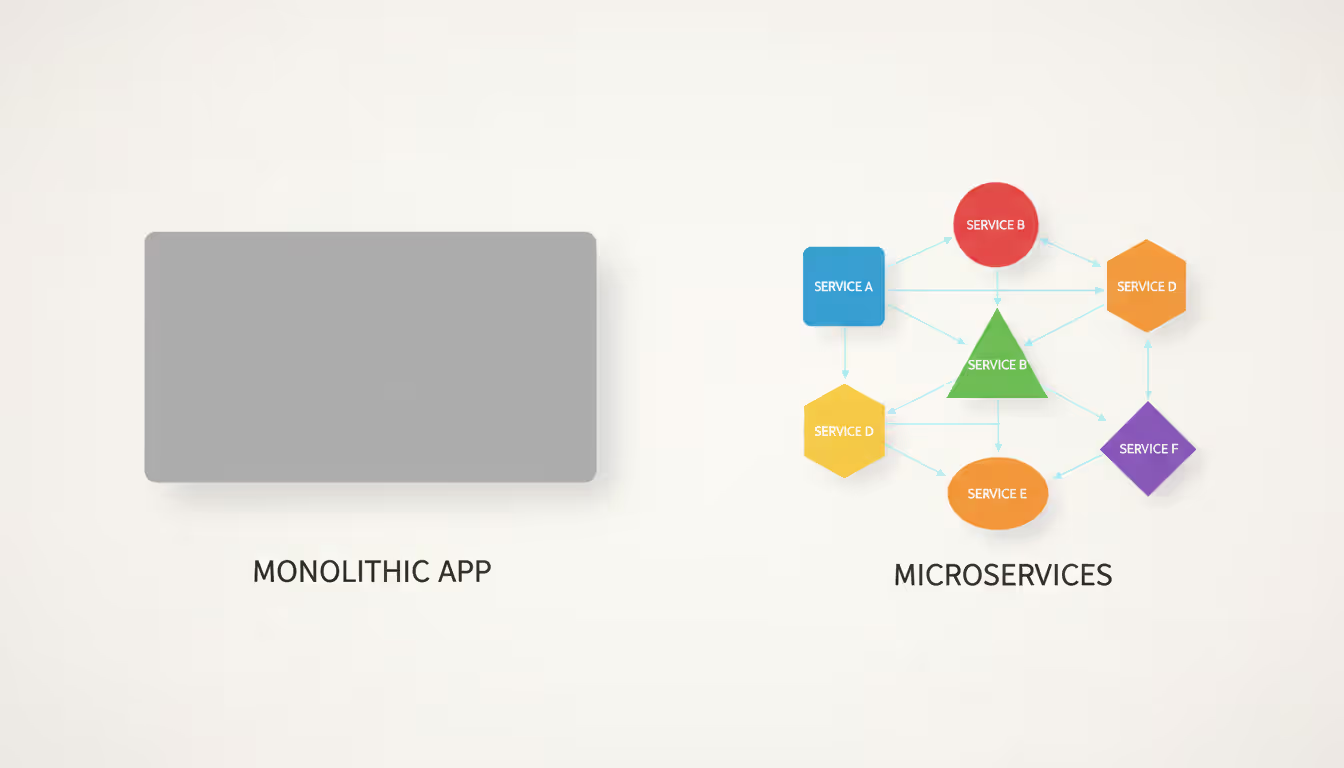
Earlier software paradigms combined every feature into one unified codebase running as a single deployment artifact. Consider an online retail platform built this way: customer login, inventory browsing, shopping basket management, transaction processing, and warehouse systems all operate within the same application instance. When traffic spikes hit the checkout process, the entire application stack needs replication, regardless of whether other components face similar demand.
Cloud native patterns break these monolithic systems into autonomous components. Individual capabilities—user verification, product listings, cart functionality—become discrete services maintaining their own databases and running within isolated containers. Teams can independently scale, modify, and diagnose each component without disrupting other system parts.
This architectural shift becomes obvious during system failures. Monolithic application crashes bring down complete functionality across all features. Microservice failures affect only specific capabilities while surrounding features continue normal operation. When payment processing experiences downtime, shoppers can still explore products, read reviews, and save items to wish lists.
Applications built for cloud environments treat infrastructure as programmable resources that exist temporarily rather than permanently. Services operate independently of specific physical machines or persistent local disk storage. Resources defined through code can spin up, terminate, and recreate on demand based on current requirements.
Author: Megan Holloway;
Source: baltazor.com
Core Principles of Cloud-Native Architecture
Cloud native architecture rests on five essential building blocks: breaking applications into microservices, packaging workloads in containers, automated orchestration, declarative configuration interfaces, and infrastructure immutability.
The microservices pattern divides applications into focused services handling specific business functions through well-structured API communication. Individual services encapsulate distinct business logic and maintain development, deployment, and scaling independence. This autonomy introduces new coordination challenges including managing distributed data transactions, accounting for network latency, and implementing service discovery mechanisms.
Container technology wraps application code alongside all required dependencies into uniform execution units that behave identically regardless of environment. Each container image bundles the runtime environment, system libraries, and configuration settings necessary for service operation. This consistency eliminates environment-specific bugs and streamlines deployment automation.
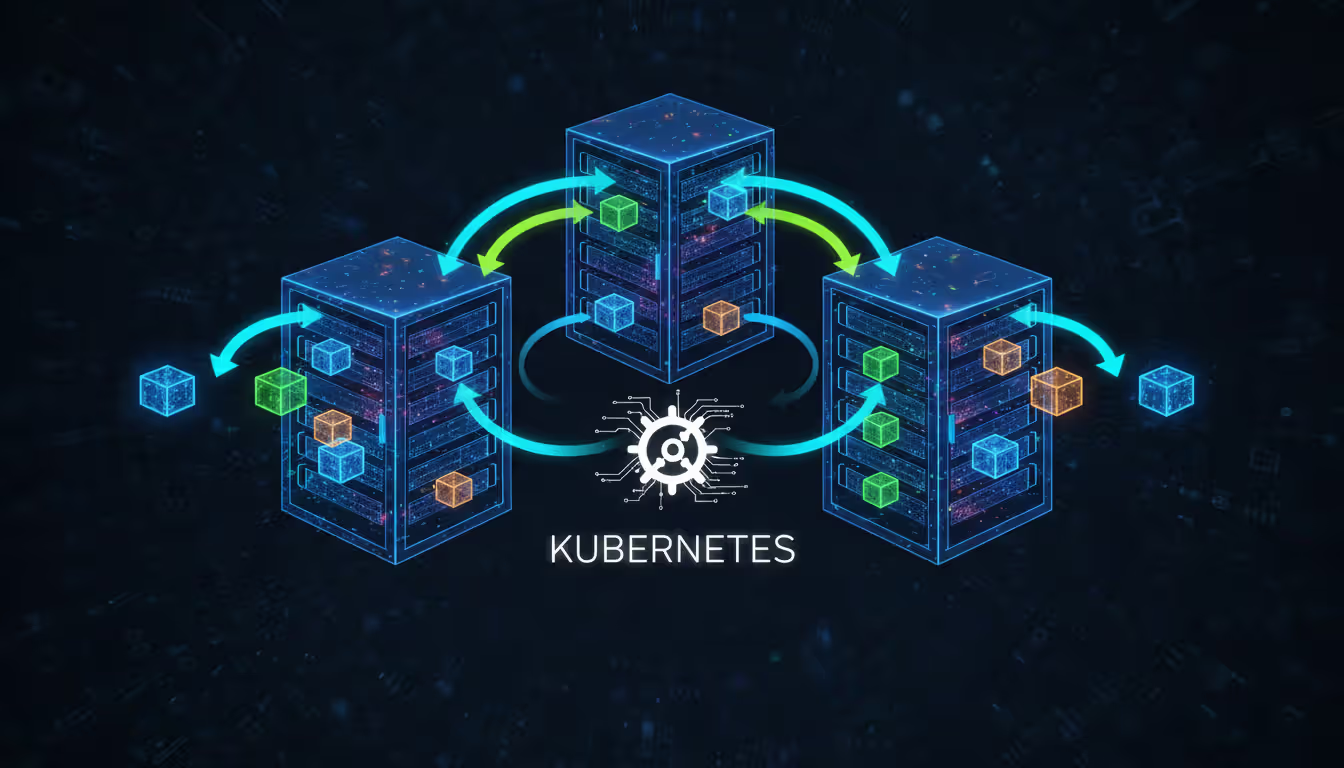
Platforms like Kubernetes automate how containers deploy, scale, and operate. These orchestration systems manage health monitoring, traffic distribution, update rollouts, and automatic recovery. Failed containers restart automatically. Traffic surges trigger additional instance creation without manual intervention.
Declarative configuration allows developers to define target system states instead of writing step-by-step procedures. Rather than coding "launch three web servers, configure traffic balancing, mount storage volumes," you specify "maintain three service replicas" and let the platform continuously align actual conditions with declared intentions.
Infrastructure immutability means treating compute resources as replaceable components. Updates happen by building fresh versions and swapping out old resources rather than modifying running systems. This methodology prevents configuration inconsistencies and simplifies rollback procedures—just redeploy the prior version.
Microservices vs Monolithic Architecture
Monolithic designs work well for applications with predictable requirements, compact development teams, and simple deployment scenarios. A documentation platform serving 10,000 readers might perform excellently as one unified application, avoiding distributed system operational overhead.
The microservices pattern shines when different features need distinct scaling profiles, multiple teams collaborate on shared codebases, or specific functions benefit from different technology choices. A media streaming service might leverage Go for high-throughput video encoding, Python for personalization algorithms, and Node.js for interactive messaging features.
The transition threshold typically arrives when a single repository grows too large for one team to comprehend fully, release cycles stall because unrelated changes create bottlenecks, or particular features require independent resource scaling. An application serving 100 requests per second might not warrant microservices overhead, but one handling 100,000 requests with fluctuating load patterns across different features likely benefits from the pattern.
Common pitfall: Teams decompose monoliths into microservices before establishing comprehensive monitoring and request tracing capabilities. They quickly discover that debugging distributed architectures demands entirely different tooling and expertise compared to troubleshooting applications running in single processes.
The Role of Containers and Kubernetes
Containers establish the packaging standard; Kubernetes delivers the runtime platform. While Docker made containers mainstream, the Open Container Initiative (OCI) now maintains industry specifications that various container runtimes support.
Kubernetes orchestrates container lifecycles across machine clusters. The platform determines which physical servers execute each container, tracks operational health, manages inter-service networking, and provisions persistent storage. Standard Kubernetes implementations include these components:
Pods: The atomic deployment unit, typically holding one primary container plus optional auxiliary containers for logging or network proxying.
Services: Persistent network addresses that distribute incoming traffic across pod instances.
Deployments: Specification documents declaring desired pod quantities, update procedures, and resource constraints.
ConfigMaps and Secrets: External configuration data and sensitive credentials injected into running containers.
Kubernetes brings considerable operational complexity. Smaller projects might adopt managed container platforms such as AWS Fargate or Google Cloud Run, which deliver container orchestration without demanding Kubernetes expertise. These platforms handle underlying infrastructure while maintaining containerization advantages.
Practical guideline: Running fewer than ten services or lacking dedicated operations personnel suggests evaluating managed container platforms before committing to Kubernetes. The orchestrator's capabilities become necessary when managing multiple dozen services spanning various deployment environments.
Author: Megan Holloway;
Source: baltazor.com
How to Build Cloud-Native Applications
Constructing cloud-native applications begins with domain analysis. Map bounded contexts—separate business logic areas with distinct boundaries. An order fulfillment system might isolate inventory tracking, payment authorization, and delivery coordination into independent services.
Architectural patterns: Deploy API gateways that establish unified client entry points while directing requests to corresponding backend services. Add circuit breaker logic that stops failure propagation when dependent services experience issues. Employ the sidecar pattern for handling cross-functional concerns like telemetry collection and logging without mixing these into core business logic.
Selecting your technology foundation: Match programming languages and frameworks to individual service needs. Services processing high-volume data streams might use Go or Rust for execution speed. Core business logic might leverage Java or C# for comprehensive ecosystem maturity. Database selection should reflect usage patterns—relational systems for transactional guarantees, document databases for schema flexibility, key-value stores for caching layers.
Contract-first API development: Establish service interfaces before writing implementation code. Document REST endpoints using OpenAPI specifications or define gRPC contracts with Protocol Buffers. This methodology enables concurrent development—frontend engineers build against published API contracts while backend teams implement actual services.
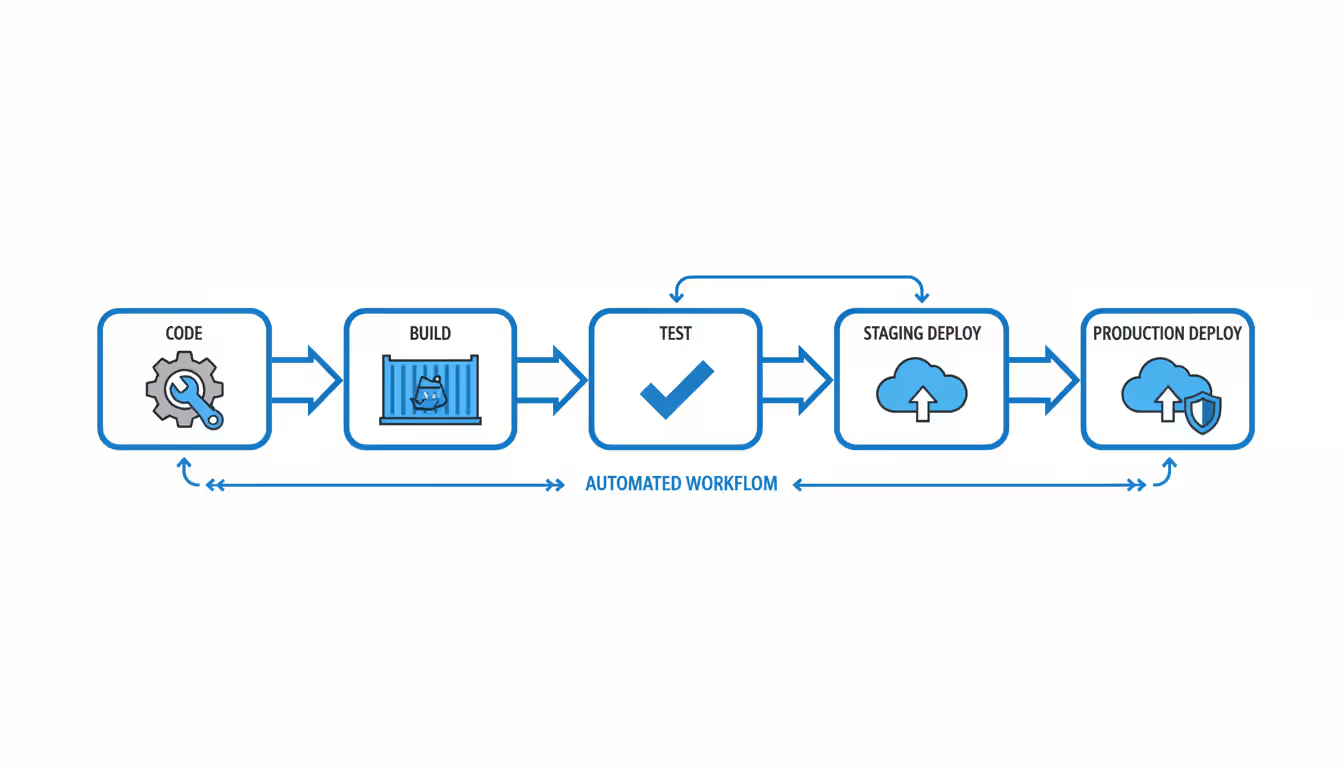
Automated integration and delivery: Build pipelines that handle testing and deployment automatically. Standard workflows execute unit test suites, construct container images, publish images to registries, deploy to staging clusters, run integration test scenarios, then promote to production following approval gates. GitOps methodologies store infrastructure configuration as versioned code, with automated systems continuously synchronizing cluster state against repository definitions.
Real-world example: A retail organization modernizing its product catalog might construct a new catalog service that initially reads from the legacy database. The existing monolith continues managing write operations while the new service assumes read traffic, enabling incremental migration with straightforward rollback options if problems emerge.
Author: Megan Holloway;
Source: baltazor.com
Cloud-Native Development Best Practices
Twelve-factor app principles establish core guidelines for cloud-native software:
Codebase tracking: Maintain a single repository with version control, deploying to multiple environments from the same source.
Dependency isolation: Declare all dependencies explicitly and package them with the application instead of assuming system-wide libraries exist.
External configuration: Store environment-specific settings in environment variables rather than hardcoding values.
Attached resources: Reference databases, queues, and caches as networked services accessible through connection strings.
Deployment phase separation: Maintain clear boundaries between building artifacts, creating releases, and executing runtime processes with immutable releases.
Stateless execution: Run application logic as processes that don't retain local state, persisting all data in backing services.
Self-contained services: Bind to network ports and expose functionality without requiring separate server software.
Horizontal scaling: Distribute workload across multiple identical processes rather than enlarging individual process capacity.
Fast startup and clean shutdown: Optimize for quick process initialization and graceful termination that preserves data integrity.
Environment consistency: Minimize differences between development, staging, and production environments.
Stream-based logging: Write log output to standard output streams and delegate aggregation to infrastructure.
Administrative task isolation: Execute maintenance operations as standalone processes within the same environment configuration.
Designing stateless services means avoiding local session storage within service instances. User session data resides in Redis or comparable caching layers, allowing any service instance to process any incoming request. This architecture enables horizontal scaling—provisioning additional instances to accommodate increased demand.
Extend automation beyond deployment workflows. Automate container image security scans, dependency vulnerability assessments, and regulatory compliance checks. Solutions like Trivy examine images for known security flaws before production deployment.
Security practices encompass secrets handling (leverage dedicated vaults like HashiCorp Vault instead of exposing sensitive credentials through environment variables), network segmentation policies (limit which services can establish communication), and minimum privilege enforcement (execute containers as non-root users with restricted permissions).
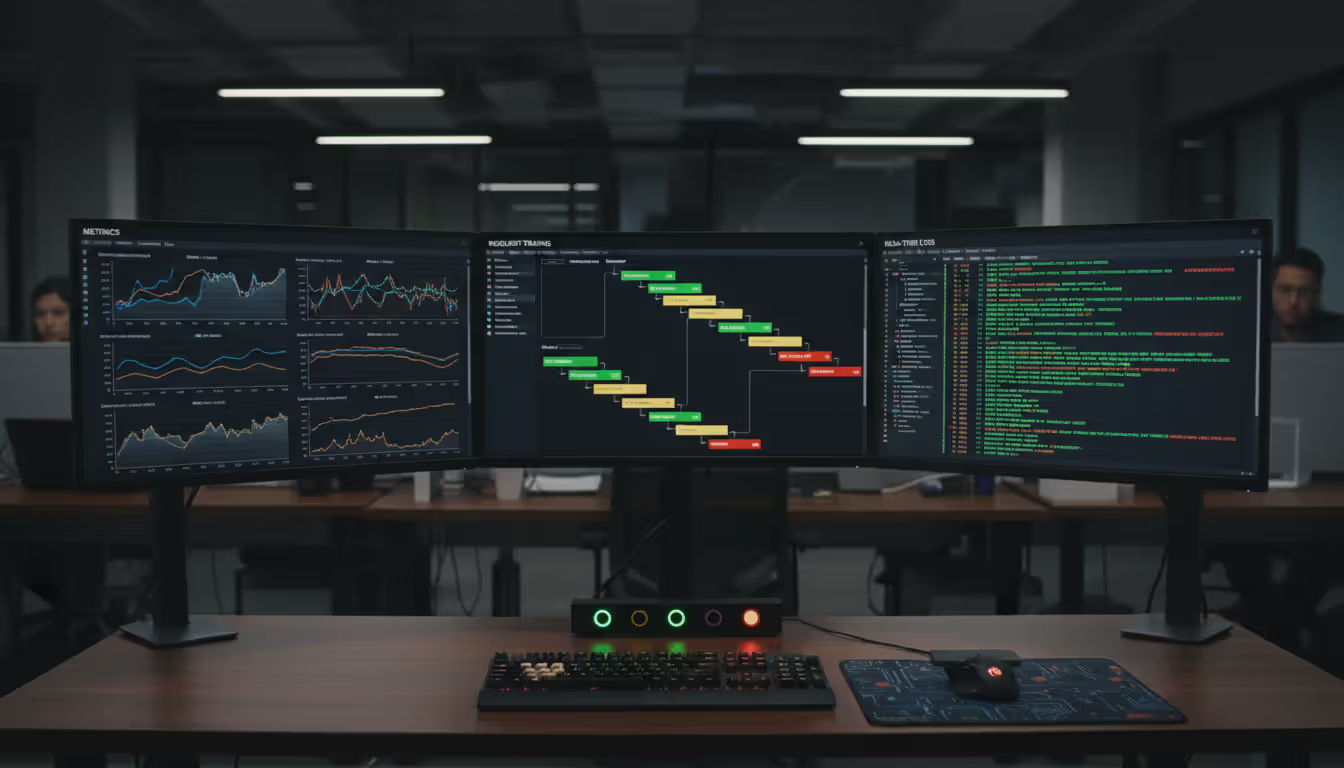
Building observability into initial development means instrumenting applications for metrics emission, log generation, and trace collection before first deployment. Surface Prometheus metrics covering both resource consumption and business performance indicators. Structure log entries as JSON documents for simplified parsing. Deploy distributed tracing to track request journeys across service boundaries.
Cloud-Native Monitoring Tools and Observability
Complete observability requires three data types: metrics, logs, and traces. Metrics deliver quantitative measurements tracked over time—transaction rates, failure percentages, latency distributions. Logs record individual events with surrounding context. Traces map individual request paths through distributed architectures, identifying participating services and time allocation.
Tool
Primary Function
Pricing Model
Best Use Case
Integration Complexity
Prometheus
Time-series metrics gathering and alerting
Open source without licensing costs
Collecting custom application metrics with flexible querying
Medium—demands configuration of scrape targets and storage backend
Grafana
Data visualization and dashboard creation
Open source with optional commercial hosting
Building visual dashboards from multiple data sources
Low—connects to existing metric stores through data source plugins
Jaeger
Request tracing across services
Open source without fees
Following request flows through microservice architectures
Medium—requires application instrumentation and collector deployment
Datadog
Comprehensive observability platform
Host-based pricing starting at $15-23 monthly per host
Consolidated metrics, logs, and traces with application performance tracking
Low—agent deployment with automatic service discovery
New Relic
Application performance insights
Usage-based billing at $0.30 per GB ingested plus user licensing
Application-focused monitoring with business impact analysis
Low—language agents with built-in automatic instrumentation
Prometheus specializes in gathering metrics from cloud-native workloads. Services expose HTTP endpoints that Prometheus polls at regular intervals. The PromQL query language enables sophisticated metric aggregation and alert condition definition. Many teams combine Prometheus for metrics collection with Grafana for visualization dashboards.
Jaeger supports OpenTelemetry standards for distributed request tracing. Adding OpenTelemetry SDK instrumentation to applications automatically generates trace data revealing request pathways, service interdependencies, and latency sources. Trace analysis might reveal that slow API performance stems from inefficient database queries in a downstream service rather than the initial request handler.
Commercial observability platforms including Datadog and New Relic deliver comprehensive monitoring with reduced operational demands. They unify metrics, logs, and traces within integrated interfaces offering preconfigured dashboards, automated anomaly detection, and cross-signal correlation. The tradeoff involves cost—high-scale deployments generate significant monthly expenses tied to data ingestion volume.
Cloud-native isn't just about technology—it's about building systems that embrace failure as normal and use automation to maintain reliability despite constant change. The goal is reducing the time between identifying a problem and deploying a fix, not eliminating problems entirely
— Kelsey Hightower
Effective monitoring demands establishing service level objectives (SLOs)—quantifiable reliability targets. An API service might target 99.9% uptime and 95th percentile latency under 200 milliseconds. Monitoring infrastructure triggers alerts when measurements approach SLO boundaries, enabling preventive action before customer experience suffers.
Common Challenges in Cloud-Native Development
Distributed architectures multiply system complexity exponentially. Monolithic applications involve one repository, one deployment pipeline, and one database connection. Microservice ecosystems might encompass 20 independent services, each maintaining separate code repositories, CI/CD automation, and data persistence layers. This distribution complicates testing strategies, debugging workflows, and understanding overall system behavior.
Team skill requirements expand significantly beyond conventional development practices. Engineers need proficiency with container orchestration platforms, service mesh configuration, distributed system design patterns, and cloud provider service APIs. Organizations frequently underestimate both the learning investment and ongoing operational workload.
Financial management grows more challenging when infrastructure responds dynamically to demand. Kubernetes environments can automatically spawn hundreds of containers based on traffic patterns. Without appropriate resource quotas and cost monitoring, cloud expenditures can escalate rapidly. Forgotten development environments, excessive instance provisioning, and inefficient container resource allocation contribute to budget waste.
Security attack surfaces expand with additional components and external dependencies. Individual container images package base operating systems, runtime environments, third-party libraries, and application binaries—each representing potential vulnerability sources. Automated vulnerability scanning and rapid patch deployment become operational requirements. The 2021 Log4Shell incident illustrated how single library vulnerabilities can compromise thousands of containerized workloads.
Troubleshooting distributed systems demands fundamentally different approaches compared to monolithic debugging. Failed requests might traverse five microservices, three database systems, and two message queues. Traditional step-through debuggers cannot follow execution across service boundaries. Engineers rely on distributed tracing platforms, correlation identifiers that track requests through the system, and centralized log aggregation.
Network reliability becomes a first-class architectural concern. Microservices exchange data across networks experiencing latency variability, occasional packet loss, and temporary partitions. Applications must gracefully handle these conditions using request timeouts, exponential backoff retry logic, and circuit breaker patterns.
Author: Megan Holloway;
Source: baltazor.com
Maintaining data consistency across service boundaries introduces unique challenges. Traditional ACID database transactions don't extend across microservice deployments. Development teams implement eventual consistency models and saga patterns for distributed transaction coordination, accepting temporary data inconsistency to achieve operational scalability.
Frequently Asked Questions
What is the difference between cloud-native and cloud-based?
Cloud-based applications simply run on cloud infrastructure instead of physical data center servers. You could deploy a traditional monolithic application to AWS EC2 virtual machines—that makes it cloud-based without being cloud-native. Cloud-native applications are architecturally designed to leverage cloud platform features including automatic scaling, managed infrastructure services, and distributed deployment models. These applications use containerization, microservice decomposition, and infrastructure-as-code practices to achieve resilience and elasticity that cloud-hosted monoliths cannot provide.
Do I need Kubernetes for cloud-native development?
Kubernetes is not required for cloud-native development. While Kubernetes offers powerful orchestration capabilities, it introduces significant operational complexity. Managed container platforms like AWS App Runner, Google Cloud Run, or Azure Container Instances provide orchestration benefits without Kubernetes learning curves. Serverless computing platforms including AWS Lambda enable cloud-native architectural patterns without any container management. Select Kubernetes when you require precise orchestration control, operate dozens of interconnected services, or need deployment portability across cloud providers. Smaller applications often gain more value from simpler managed platforms.
How much does it cost to build a cloud-native application?
Cloud-native development costs vary dramatically based on application scale and architectural decisions. A modest application running three microservices might consume $200-500 monthly on managed container platforms. Enterprise systems with dozens of services, global availability requirements, and substantial traffic volumes can require $10,000-50,000 monthly infrastructure spending or more. Primary cost factors include container compute resources, cross-service and cross-region data transfer, managed database subscriptions, and commercial observability platform fees. Development expenses also rise due to architectural complexity—anticipate 20-40% longer initial development timelines compared to equivalent monolithic applications.
What programming languages are best for cloud-native apps?
Cloud-native development doesn't favor a single programming language. Go gained adoption for infrastructure tooling and high-performance services because of its concurrency primitives and compact compiled binaries. Java and C# remain prevalent for enterprise microservices supported by mature frameworks like Spring Boot and .NET. Python excels for data pipeline and machine learning services. Node.js fits real-time and I/O-heavy workloads effectively. Select languages based on team capabilities and specific service requirements rather than chasing industry trends. Using different languages across different services—polyglot architectures—is common practice in cloud-native environments.
Is cloud-native development suitable for small businesses?
Small businesses can extract value from cloud-native methodologies but should adopt them incrementally. Start with managed services that minimize operational overhead—leverage managed databases, serverless compute functions, and platform-as-a-service offerings instead of operating Kubernetes clusters. Embrace containers for deployment consistency without immediately decomposing applications into microservices. As business scale and complexity grow, progressively adopt additional cloud-native patterns. The primary small business advantage involves eliminating large upfront infrastructure capital expenses and consuming resources proportional to actual usage.
How do cloud-native applications improve scalability?
Cloud-native applications achieve scalability by expanding horizontally through additional service instances rather than vertically through larger individual servers. When traffic volume increases, orchestration platforms automatically provision additional container instances of affected services. During reduced demand periods, surplus instances terminate automatically, reducing operating costs. Stateless service design enables this dynamic behavior—each instance can process any incoming request without depending on local state. Automated scaling policies trigger based on operational metrics including CPU utilization, memory pressure, or request queue depth. This elasticity allows applications to handle unpredictable traffic patterns without manual intervention or maintaining constant excess capacity.
Cloud-native application development fundamentally transforms how organizations architect and operate software systems. The foundational patterns—microservice decomposition, containerization, automated orchestration, and declarative infrastructure management—enable applications to scale elastically, recover from failures automatically, and evolve continuously through independent service releases.
Achieving success requires more than technology adoption. Organizations must cultivate new engineering capabilities, accept higher initial complexity, and commit to comprehensive automation and observability practices. Twelve-factor methodology offers actionable guidance, while monitoring solutions including Prometheus, Grafana, and Jaeger provide visibility into distributed system performance.
Begin your cloud-native journey incrementally. Containerize existing applications before restructuring them into microservices. Leverage managed cloud services to minimize operational burden during the learning process. Establish CI/CD automation and observability foundations early in development cycles. Most critically, align architectural choices with genuine business needs rather than implementing patterns based solely on industry popularity.
Cloud-native approaches deliver measurable benefits—accelerated release velocity, enhanced fault tolerance, and optimized resource consumption—but these advantages accompany tradeoffs in system complexity and operational requirements. Assess whether your application's scale, change frequency, and availability demands justify the investment. For growing numbers of organizations in 2025, cloud-native architecture increasingly becomes essential, but the migration path should match your team's current capabilities and actual business objectives.
A software defined network (SDN) separates control intelligence from physical equipment, enabling centralized management and programmable network behavior. Discover the three-layer architecture, key components, and how SDN transforms enterprise networking
A complete guide to setting up an intranet for your organization. Covers planning requirements, choosing between cloud and self-hosted platforms, technical setup steps, common mistakes to avoid, and strategies for maintaining and scaling your intranet over time
Remote desktop hosting delivers centralized desktop environments accessible from anywhere. This guide covers infrastructure selection, security implementation with multi-factor authentication and VPN, printing solutions, and common pitfalls to avoid when deploying remote desktop services for your business
Private cloud infrastructure dedicates computing resources to a single organization, offering control and compliance advantages over shared public cloud. This guide examines architecture, platform choices, managed services options, and decision criteria for enterprises evaluating private cloud deployment
The content on this website is provided for general informational and educational purposes only. It is intended to explain concepts related to cloud computing, computer networking, infrastructure, and modern IT systems.
All information on this website, including articles, guides, and examples, is presented for general educational purposes. Technology implementations may vary depending on specific environments, business needs, infrastructure design, and technical requirements.
This website does not provide professional IT, engineering, or technical advice, and the information presented should not be used as a substitute for consultation with qualified IT professionals.
The website and its authors are not responsible for any errors or omissions, or for any outcomes resulting from decisions made based on the information provided on this website.