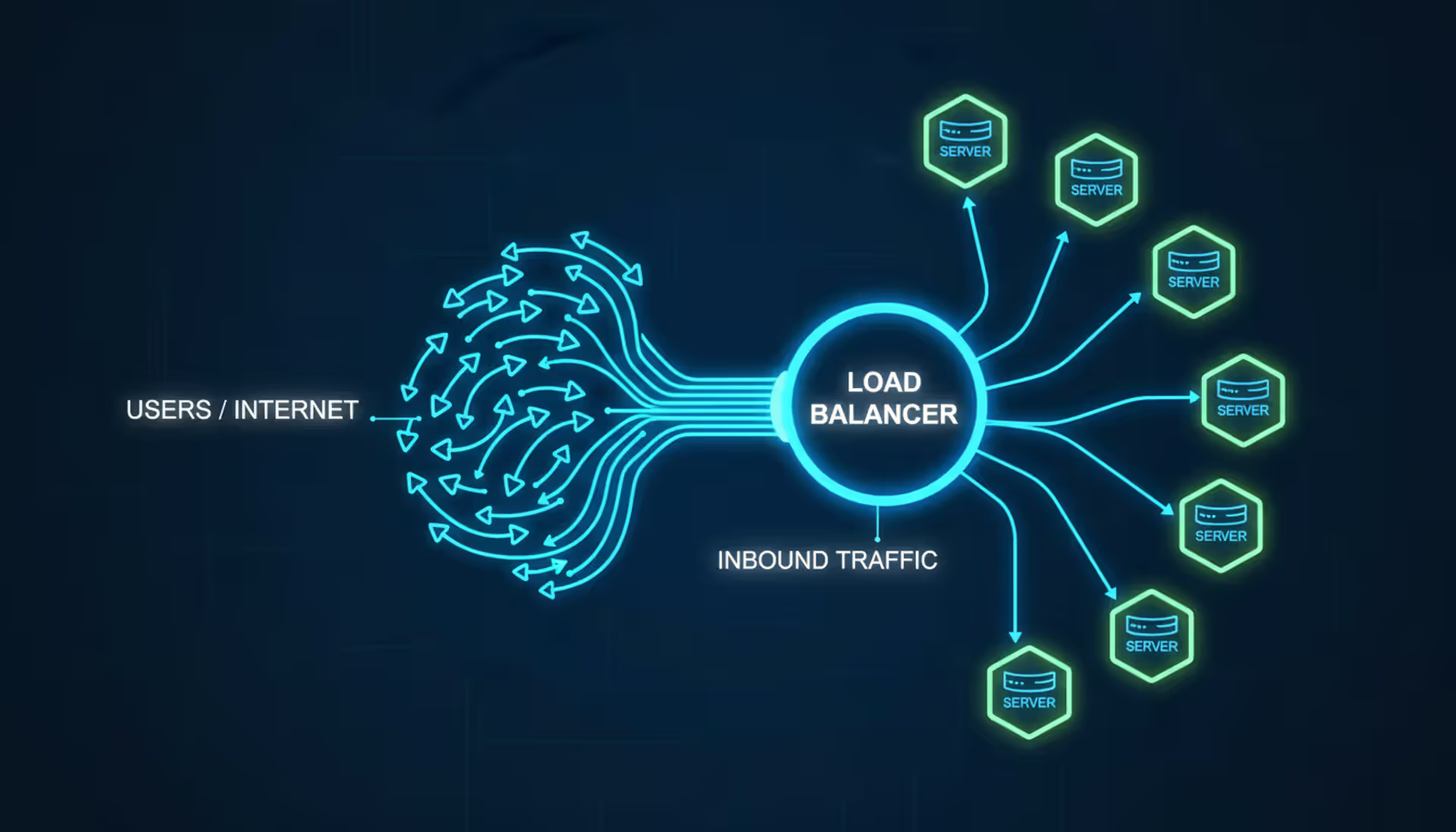
When building distributed applications, managing communication between clients and backend services becomes exponentially complex. An API gateway serves as the single entry point that orchestrates these interactions, handling everything from routing to security enforcement. Understanding how API gateways function and when to deploy them can dramatically simplify your architecture while improving performance and security.
API Gateway Definition and Core Functions
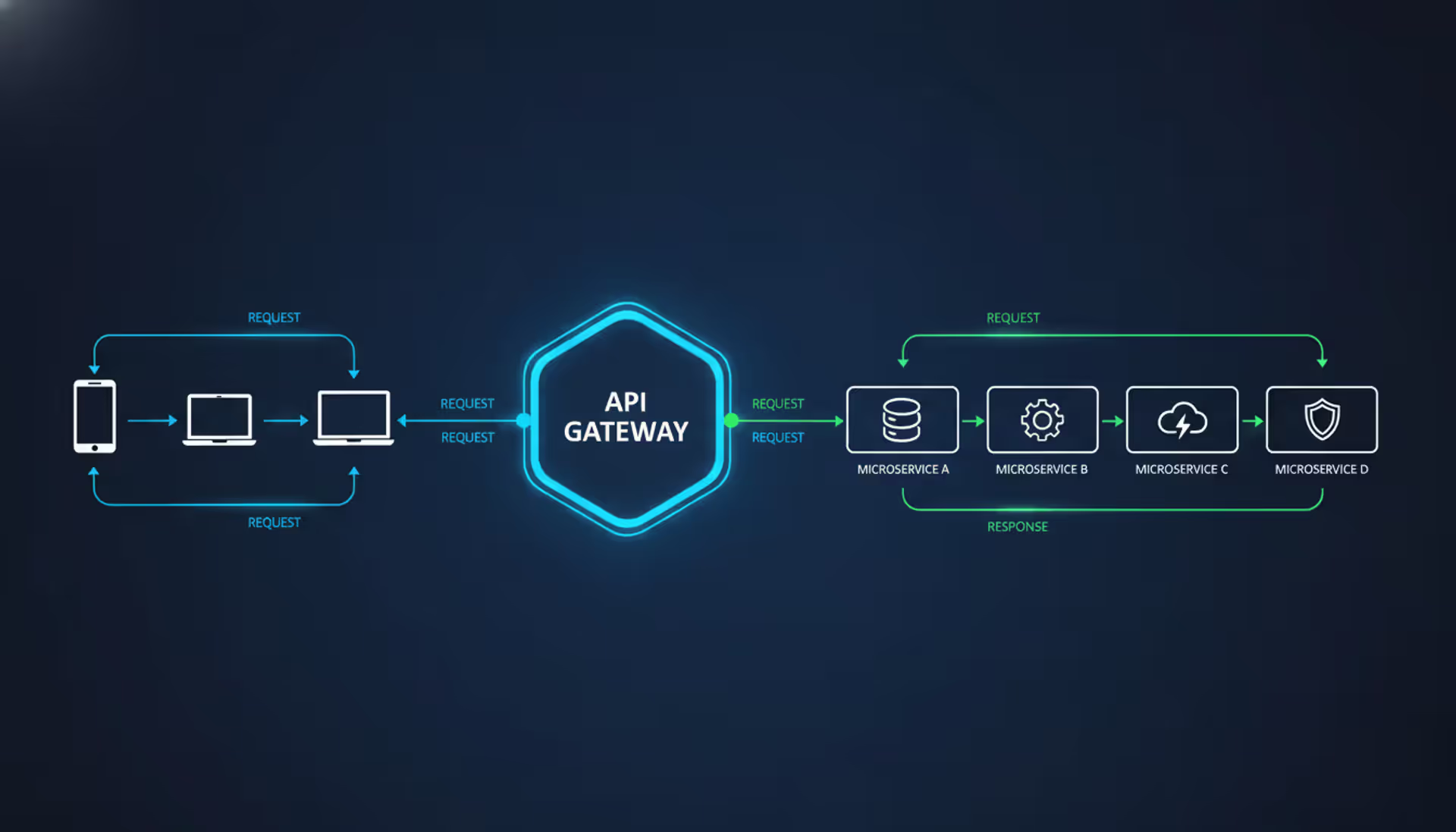
An API gateway is a server that acts as an intermediary layer between client applications and backend microservices. Think of it as a sophisticated traffic controller that receives API requests from clients, routes them to appropriate services, aggregates responses when necessary, and returns the final result to the caller.
The primary role of an API gateway centers on request routing and composition. When a mobile app requests user profile data, the gateway might need to call three separate microservices: one for basic profile information, another for purchase history, and a third for recommendation preferences. Instead of forcing the mobile client to make three separate calls and handle the complexity of combining results, the gateway performs this orchestration automatically.
Beyond simple routing, API gateways handle protocol translation. A legacy SOAP service can be exposed as a modern REST API, or internal gRPC services can be presented as GraphQL endpoints to frontend developers. This abstraction shields clients from backend implementation details and allows teams to evolve services independently.
The API gateway definition extends to its role as a policy enforcement point. Rate limits prevent abuse, authentication mechanisms verify identity, and authorization rules ensure users only access permitted resources. Rather than duplicating this logic across dozens of microservices, centralizing it in the gateway reduces code duplication and ensures consistent security posture.
Most gateways also perform request and response transformation. They can convert XML to JSON, add or remove headers, modify payload structures, and even aggregate multiple backend responses into a single unified response. This capability proves invaluable when frontend requirements don't perfectly align with backend data structures.
Key Features and Capabilities
Modern API gateways bundle numerous capabilities that address common distributed system challenges. Three features deserve particular attention for their impact on performance, security, and client compatibility.
API Gateway Caching
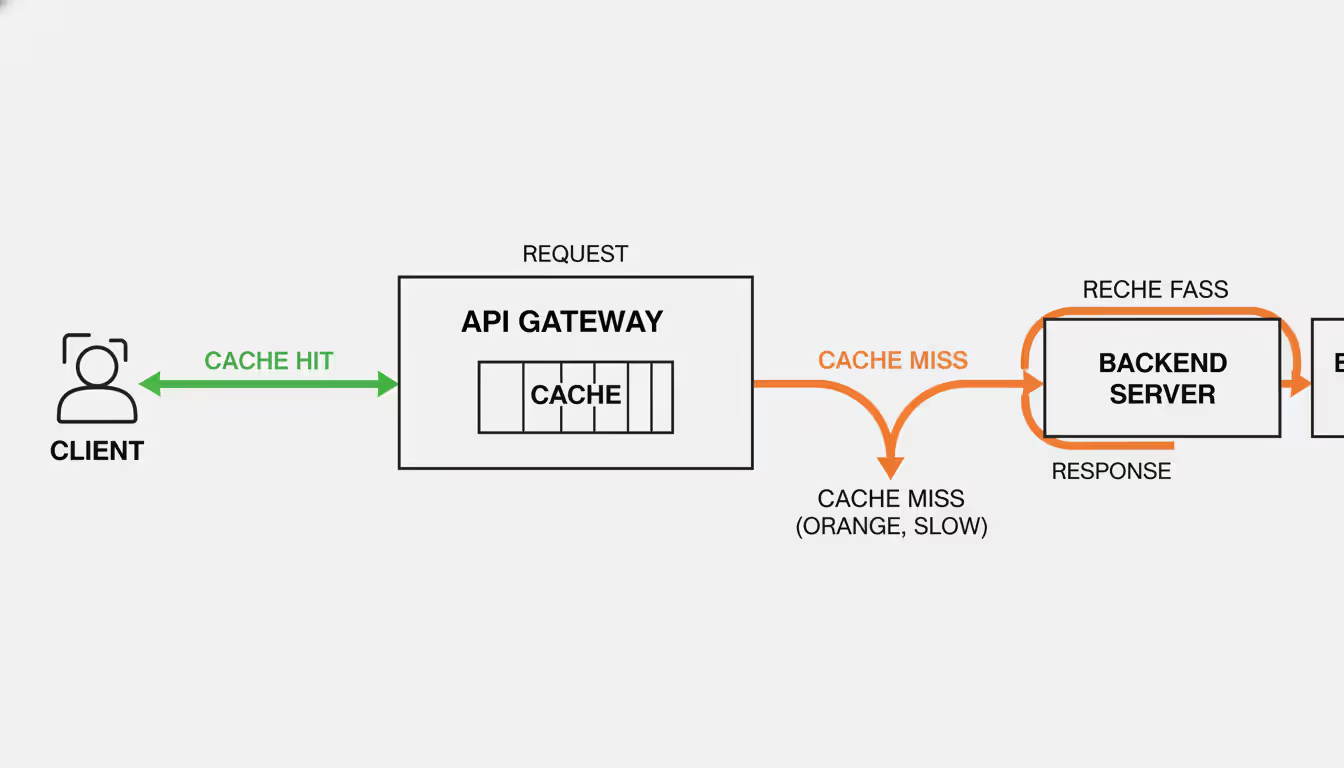
API gateway caching stores responses from backend services and serves them directly to subsequent requests without hitting the origin servers. This dramatically reduces latency for frequently accessed data and decreases load on backend systems.
Caching strategies vary based on data characteristics. Static content like product catalogs might be cached for hours, while dynamic user-specific data might only cache for seconds. The gateway inspects cache control headers from backend responses or applies configured cache policies based on URL patterns.
A common mistake involves caching personalized data with shared cache keys. If you cache a user profile response without including the user ID in the cache key, different users might receive each other's data. Proper cache key design must incorporate all variables that affect the response: user identity, query parameters, request headers like Accept-Language, and API version.
Cache invalidation presents another challenge. When a user updates their profile, the cached version must be purged or marked stale. Some gateways support programmatic cache invalidation through admin APIs, while others rely on time-to-live (TTL) expiration. For critical data consistency, shorter TTLs combined with conditional requests (using ETags) provide a reasonable compromise between performance and freshness.
The performance impact is substantial. A properly configured caching layer can reduce backend load by 60-80% for read-heavy APIs and cut response times from hundreds of milliseconds to single-digit milliseconds for cached responses.
Author: Logan Kessler;
Source: baltazor.com
API Gateway WAF Integration
API gateway WAF (Web Application Firewall) integration protects APIs from common attack vectors including SQL injection, cross-site scripting, and malicious payloads. The WAF examines incoming requests against rule sets that identify suspicious patterns before they reach backend services.
Unlike traditional WAFs designed for browser-based applications, API gateway WAF implementations understand API-specific threats. They validate JSON and XML schemas, enforce parameter types and value ranges, detect anomalous request patterns, and block requests with oversized payloads that might trigger denial-of-service conditions.
Managed rule sets from providers like OWASP provide baseline protection against known attack signatures. Custom rules address application-specific vulnerabilities. For example, if your API accepts file uploads, a custom rule might restrict file types, scan for embedded scripts, and enforce size limits.
False positives represent the main operational challenge. Legitimate requests occasionally trigger WAF rules, particularly with custom applications that use non-standard data formats. Start with the WAF in detection-only mode, analyze blocked requests over several weeks, tune rules to minimize false positives, then switch to blocking mode.
Performance overhead from WAF inspection typically adds 5-15 milliseconds per request depending on rule complexity. This cost is negligible compared to the potential damage from successful attacks. The real trade-off involves operational complexity—maintaining rule sets requires ongoing attention as your API evolves.
API Gateway CORS Configuration
API gateway CORS (Cross-Origin Resource Sharing) configuration controls which web applications can call your APIs from browsers. Without proper CORS headers, browsers block API requests from JavaScript running on different domains, breaking single-page applications and mobile web apps.
The gateway intercepts preflight OPTIONS requests that browsers send before actual API calls. It responds with appropriate Access-Control-Allow-Origin, Access-Control-Allow-Methods, and Access-Control-Allow-Headers headers based on configured policies. This centralizes CORS handling rather than requiring each microservice to implement it independently.
A conservative CORS policy might whitelist specific origins: https://app.example.com and https://mobile.example.com. More permissive configurations use wildcards, though Access-Control-Allow-Origin: * prevents credential-based requests and exposes APIs to any website. For public APIs, this might be acceptable. For authenticated APIs, explicitly list allowed origins.
Credential handling requires careful configuration. If your API uses cookies or HTTP authentication, you must set Access-Control-Allow-Credentials: true and specify exact origins—wildcards won't work. The browser enforces this strictly to prevent credential theft.
Many developers waste time debugging CORS issues that stem from misconfigured allowed headers. If your client sends custom headers like X-API-Key or X-Request-ID, you must explicitly list them in Access-Control-Allow-Headers. Missing even one header causes the browser to reject the request before it reaches your application code.
API Gateway vs Reverse Proxy
The API gateway vs reverse proxy question arises frequently because both sit between clients and servers, forwarding requests and returning responses. The distinction lies in their intended purpose and feature depth.
A reverse proxy primarily handles HTTP/HTTPS traffic forwarding with basic load balancing. It terminates TLS connections, distributes requests across backend servers, and may cache static content. NGINX and HAProxy exemplify this category—they excel at high-performance request forwarding with minimal overhead.
API gateways build on reverse proxy foundations but add API-specific functionality. They understand API semantics, enforce API contracts, perform request/response transformations, and integrate with authentication providers. Where a reverse proxy routes based on URL paths, an API gateway might route based on JWT claims, request payload content, or API version headers.
Feature
API Gateway
Reverse Proxy
Protocol Support
REST, GraphQL, gRPC, WebSocket, SOAP
Primarily HTTP/HTTPS, TCP
Authentication
OAuth 2.0, JWT, API keys, SAML
Basic/Digest auth, client certificates
Routing Logic
Content-based, header-based, claim-based
Path-based, host-based
Response Caching
Intelligent cache with invalidation
Static content caching
Rate Limiting
Per-user, per-API, quota management
Basic connection limiting
Request Transformation
Protocol conversion, aggregation, filtering
Minimal header manipulation
Typical Use Cases
Microservices, API management, mobile backends
Load balancing, TLS termination, static sites
The performance characteristics differ significantly. Reverse proxies handle 50,000+ requests per second on modest hardware because they perform minimal processing. API gateways process 5,000-15,000 requests per second depending on enabled features. Each authentication check, transformation, and policy evaluation adds microseconds to milliseconds of latency.
Use a reverse proxy when you need simple load balancing and TLS termination for a monolithic application. Choose an API gateway when managing multiple microservices, enforcing API contracts, or providing a unified API facade to diverse clients. Many architectures use both—a reverse proxy at the edge for TLS and DDoS protection, with an API gateway behind it handling API-specific concerns.
Common Use Cases and Benefits
API gateways solve specific architectural challenges that emerge when applications grow beyond simple client-server patterns.
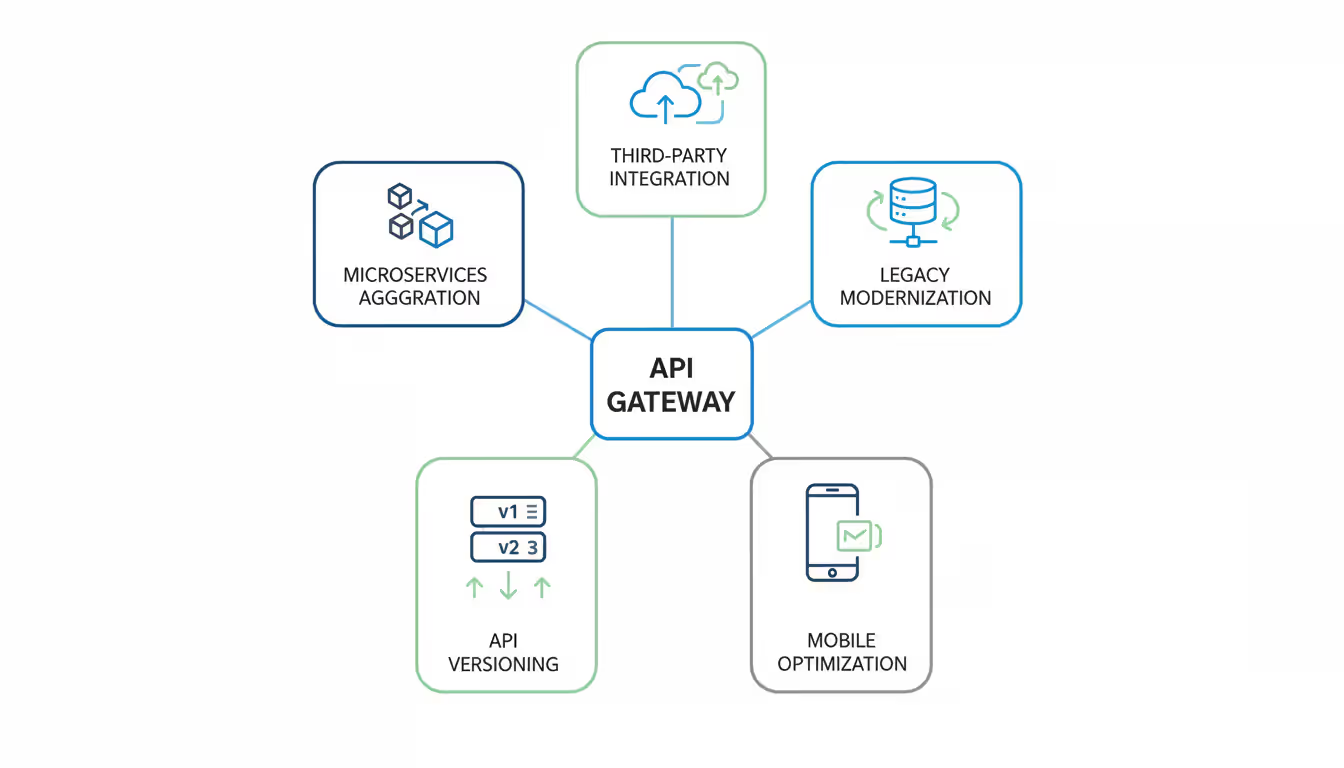
Microservices aggregation ranks among the most common use cases. A product detail page might require data from inventory, pricing, reviews, and recommendation services. Without a gateway, the mobile app makes four sequential calls, each with network overhead. The gateway fans out these requests in parallel, waits for all responses, combines them into a single payload, and returns it to the client. Response time drops from 800ms (4 × 200ms) to 200ms plus minimal aggregation overhead.
Legacy system modernization leverages gateways to gradually migrate from monolithic architectures. The gateway routes new API endpoints to modern microservices while proxying legacy endpoints to the old system. Clients see a unified API surface regardless of backend implementation. As you migrate functionality, you simply update routing rules without changing client code.
API versioning and deprecation becomes manageable through gateway-based routing. Version 1 clients receive responses from legacy services, version 2 clients hit new services, and the gateway handles the routing based on version headers or URL paths. When deprecating old versions, the gateway can inject warning headers, log usage patterns to identify stragglers, and eventually block access after a grace period.
Mobile and IoT optimization addresses bandwidth and battery constraints. The gateway compresses responses, strips unnecessary fields based on device capabilities, and implements efficient binary protocols like Protocol Buffers for mobile clients while maintaining JSON for web clients. A single backend service supports all client types without platform-specific code.
Third-party API integration abstracts external dependencies behind your own API contracts. When a payment provider changes their API, you update gateway transformation rules rather than redeploying every service that processes payments. The gateway also enforces retry logic, circuit breaking, and fallback responses when external APIs fail.
The cumulative benefits extend beyond individual use cases. Development teams move faster because they don't implement cross-cutting concerns in every service. Operations teams gain centralized observability—every API call flows through a single point where you can log, trace, and monitor. Security teams enforce policies consistently without relying on developers to implement them correctly in dozens of services.
Author: Logan Kessler;
Source: baltazor.com
How API Gateways Handle Security and Performance
Security and performance often conflict—strong security adds latency, aggressive caching risks serving stale data. API gateways navigate these trade-offs through layered approaches.
Authentication and authorization occur at the gateway before requests reach backend services. The gateway validates JWT tokens, calls OAuth authorization servers, or checks API keys against a database. Once authenticated, it injects user identity into backend requests through headers or modified tokens. Backend services trust these injected identities because requests can only arrive through the authenticated gateway.
Multi-factor authentication integrates at the gateway level. Step-up authentication challenges users for sensitive operations—viewing account details might require only a password, but transferring funds triggers an additional verification. The gateway enforces these policies based on endpoint patterns and user context.
Rate limiting and throttling prevent abuse and ensure fair resource allocation. Per-user limits might allow 1,000 requests per hour, while per-API limits protect specific endpoints from overload. The gateway tracks request counts in distributed caches (Redis) or local memory, rejecting requests that exceed thresholds with 429 Too Many Requests responses.
Sophisticated rate limiting uses token bucket or leaky bucket algorithms that allow bursts while enforcing average rates. A user might burst to 100 requests per second briefly but average only 10 requests per second over a minute. This flexibility accommodates legitimate usage patterns while blocking sustained abuse.
Load balancing distributes requests across backend instances using various algorithms. Round-robin works for stateless services with identical instances. Least-connections routes to the instance handling the fewest active requests. Weighted routing sends more traffic to larger instances. Health checks automatically remove failed instances from rotation.
Session affinity (sticky sessions) routes requests from the same user to the same backend instance, necessary for stateful services that maintain in-memory session data. The gateway uses cookies or consistent hashing to maintain affinity while still load balancing across the user population.
Request and response transformation adapts data formats without changing backend code. Renaming fields, flattening nested structures, filtering sensitive data from responses, and converting between data formats all happen transparently. A backend service returns timestamps in Unix epoch format, but the gateway converts them to ISO 8601 strings for client convenience.
Circuit breaking prevents cascading failures when backend services become unhealthy. After a threshold of failed requests, the gateway "opens" the circuit and returns immediate errors instead of waiting for timeouts. Periodic test requests check if the service recovered, "closing" the circuit when it responds successfully. This protects both the failing service and the gateway itself from overload.
The API gateway has evolved from a simple routing layer to the central nervous system of distributed applications. Organizations that treat it as an afterthought inevitably face scaling and security challenges that could have been solved architecturally from the start
— Martin Fowler
Choosing an API Gateway Solution
Selecting an API gateway involves evaluating technical capabilities, operational models, and cost structures against your specific requirements.
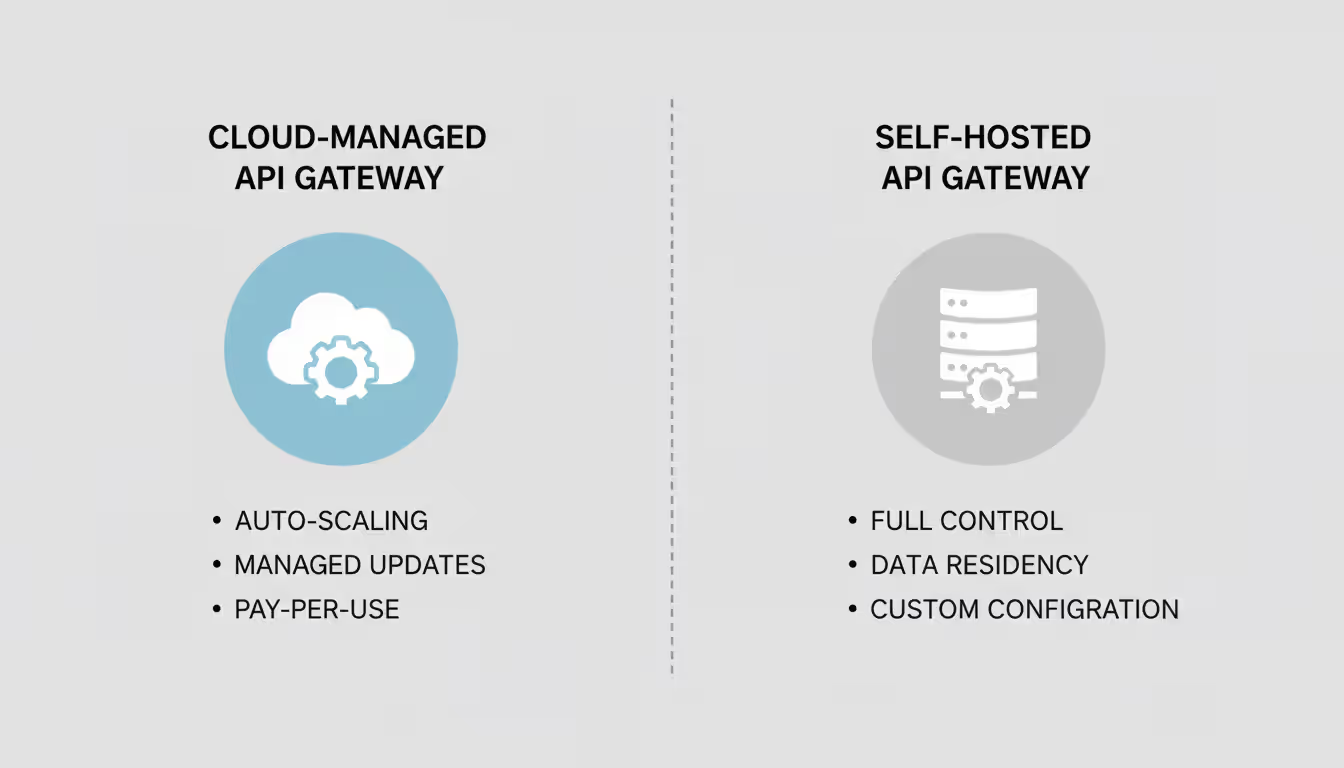
Cloud-native vs. self-hosted represents the first major decision. Cloud providers offer managed gateways (AWS API Gateway, Google Cloud API Gateway, Azure API Management) that handle infrastructure, scaling, and updates. You configure policies through web consoles or infrastructure-as-code, and the provider manages the rest. Self-hosted options like Kong, Tyk, or Apigee hybrid give you complete control but require operating and scaling the gateway infrastructure yourself.
Managed gateways make sense for teams without dedicated platform engineering resources or applications with variable traffic patterns that benefit from automatic scaling. Self-hosted gateways suit organizations with strict data residency requirements, existing Kubernetes infrastructure, or cost sensitivity at very high request volumes where managed service pricing becomes expensive.
Author: Logan Kessler;
Source: baltazor.com
Pricing models vary dramatically. AWS API Gateway charges per million requests plus data transfer, making it cost-effective at low volumes but expensive at scale. Kong offers open-source and enterprise versions, with enterprise pricing based on deployment size rather than request volume. Apigee uses subscription tiers based on request volumes and feature sets.
Calculate total cost of ownership including infrastructure, licensing, and operational overhead. A managed gateway at $500/month might cost less than running self-hosted infrastructure requiring dedicated engineering time for maintenance, monitoring, and updates.
Feature requirements should drive selection beyond cost. If you need GraphQL federation, ensure the gateway supports it natively rather than requiring custom development. Multi-region active-active deployment might be critical for global applications but overkill for regional services. WebSocket support, gRPC transcoding, and service mesh integration vary widely across products.
Integration ecosystem matters for operational efficiency. Native integration with your identity provider (Okta, Auth0, Azure AD) simplifies authentication. Built-in support for your observability stack (Datadog, New Relic, Prometheus) reduces custom instrumentation. Compatibility with your CI/CD pipelines affects deployment velocity.
Performance requirements influence architecture choices. If you need sub-10ms latency, eliminate network hops by deploying gateways in the same availability zones as backend services. Extremely high throughput might require multiple gateway clusters with geographic routing. Understanding your latency budget helps right-size the solution.
Vendor lock-in deserves consideration, particularly with cloud-native managed services. Using AWS-specific features like Lambda authorizers makes migration difficult. Maintaining configuration in standard formats (OpenAPI specifications) and avoiding proprietary features preserves flexibility.
Start with a proof of concept testing your top three candidates against realistic traffic patterns and feature requirements. Synthetic benchmarks rarely match production behavior. Testing authentication flows, rate limiting under load, and failover scenarios reveals practical limitations before commitment.
Frequently Asked Questions
Do I need an API gateway for a small application?
Small applications with a single backend service and limited client types can function without a gateway. Direct client-to-service communication works fine until you add a second service, introduce mobile clients with different data requirements, or need centralized authentication. Many teams add gateways preemptively to avoid architectural refactoring later, but this adds operational complexity without immediate benefit. Add a gateway when you have three or more backend services, multiple client platforms, or security requirements that would otherwise duplicate across services.
Can an API gateway replace a load balancer?
API gateways include load balancing capabilities but don't fully replace dedicated load balancers in production environments. A gateway performs application-layer (L7) load balancing with API-aware routing, while traditional load balancers operate at transport (L4) or application layers with higher throughput and lower latency. Best practice uses both: network load balancers distribute traffic across gateway instances, and the gateway performs intelligent routing to backend services. This separation provides better scalability and fault isolation.
What is the difference between an API gateway and an API management platform?
An API gateway is the runtime component that processes API requests. An API management platform includes the gateway plus additional tools: developer portals for API documentation, analytics dashboards for usage monitoring, API lifecycle management for versioning and deprecation, and monetization features for billing API consumers. Think of the gateway as the engine and the management platform as the complete vehicle. Small teams might only need the gateway, while organizations with external API programs require full management capabilities.
How does an API gateway improve security?
Gateways improve security through multiple mechanisms: centralized authentication prevents each service from implementing auth incorrectly, rate limiting blocks brute force attacks and API abuse, WAF integration filters malicious requests, TLS termination ensures encrypted communication, and request validation rejects malformed inputs before they reach backend code. The gateway also provides a single audit point for compliance logging. However, gateways create a single point of failure if not properly secured—compromise of the gateway potentially exposes all backend services.
Does using an API gateway add latency?
Yes, gateways add latency ranging from 1-50ms depending on enabled features and implementation quality. Simple routing adds minimal overhead (1-5ms), while complex transformations, external authentication calls, and WAF inspection can add 20-50ms. This latency is usually acceptable compared to the benefits, and caching can actually reduce end-to-end latency by serving responses without hitting backend services. Measure latency in your specific environment with realistic traffic patterns before assuming it's problematic.
Can I use multiple API gateways together?
Multiple gateways in a single architecture serve different purposes. An external-facing gateway handles public API traffic with strict security, while an internal gateway manages service-to-service communication with different policies. Geographic distribution uses regional gateways to reduce latency for global users. Some architectures even chain gateways—an edge gateway for basic routing and security, with specialized gateways behind it for specific workloads. This adds complexity but provides flexibility. Ensure clear boundaries between gateway responsibilities to avoid confusion and configuration drift.
API gateways have become essential infrastructure for modern distributed applications, providing the control plane for API traffic that would otherwise require complex client-side orchestration or duplicated logic across services. The combination of routing, security, performance optimization, and protocol abstraction addresses real architectural challenges that emerge as applications scale beyond simple client-server patterns.
Choosing and implementing a gateway requires balancing technical capabilities against operational complexity and cost. Start with clear requirements around security, performance, and integration needs. Evaluate both managed and self-hosted options against your team's capabilities and infrastructure preferences. Test candidates with realistic workloads before committing to a platform.
The gateway shouldn't be an afterthought bolted onto an existing architecture—it works best when designed into your system from the start, with clear policies around routing, security, and performance. Whether you're building a new microservices architecture or modernizing a legacy monolith, understanding how API gateways work and when to deploy them will significantly impact your application's scalability, security, and maintainability.
When you print thousands of product labels or engrave a QR code onto a memorial plaque, that code must work indefinitely. Learn which QR code types never expire, how to generate permanent codes, and mistakes that can make even 'permanent' codes fail
Organizations lose $5,600 per minute during network downtime. A network traffic monitor provides visibility into data flows, enabling IT teams to maintain performance, troubleshoot issues, and detect threats before escalation. This guide covers implementation, tool selection, and best practices
Network infrastructure failures cost enterprises an average of $9,000 per minute in 2026. This comprehensive guide covers network monitoring fundamentals, tool selection, deployment options, and alert configuration best practices to help organizations maintain optimal network performance
Load balancers distribute network traffic across multiple servers to prevent overload and ensure high availability. This guide covers load balancer architecture, algorithms, DNS-based methods, cloud services vs on-premises solutions, and implementation best practices for modern infrastructure
The content on this website is provided for general informational and educational purposes only. It is intended to explain concepts related to cloud computing, computer networking, infrastructure, and modern IT systems.
All information on this website, including articles, guides, and examples, is presented for general educational purposes. Technology implementations may vary depending on specific environments, business needs, infrastructure design, and technical requirements.
This website does not provide professional IT, engineering, or technical advice, and the information presented should not be used as a substitute for consultation with qualified IT professionals.
The website and its authors are not responsible for any errors or omissions, or for any outcomes resulting from decisions made based on the information provided on this website.